
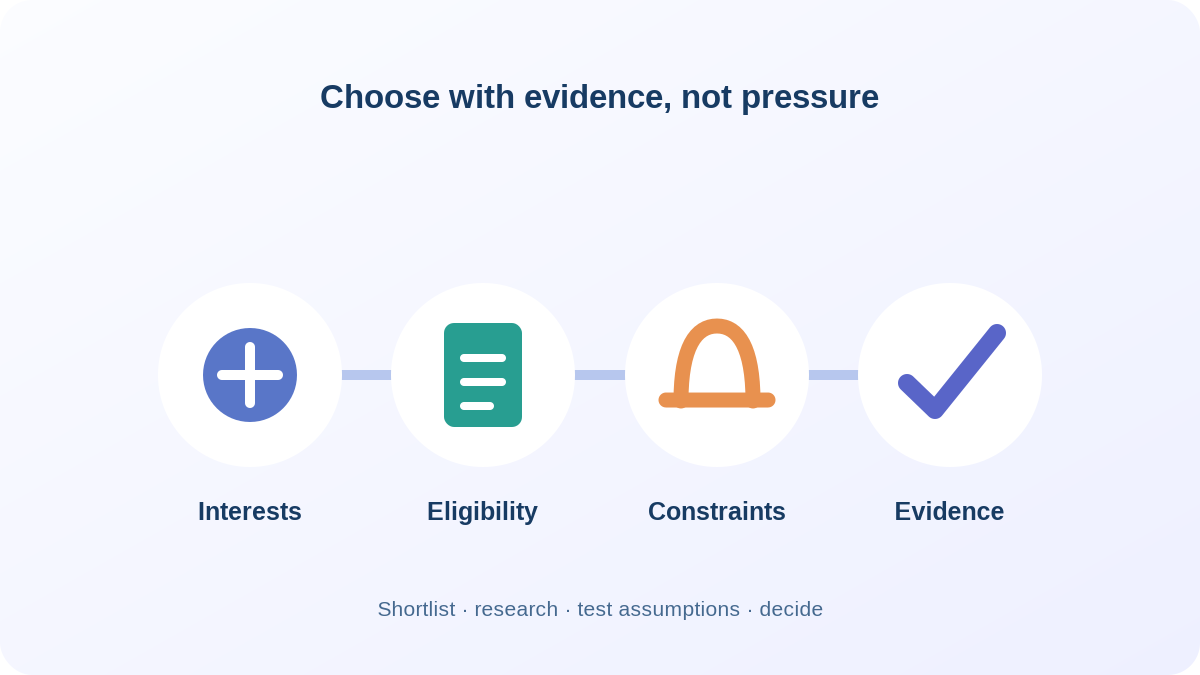
Start with the decision you are actually making
Choosing a course is not the same as choosing one permanent career. At this stage, you are choosing a next learning environment: subjects you will study, skills you will practise, people you will meet and options you may keep open. Naming that decision clearly reduces the pressure to find one perfect answer.
Write down the deadline, the applications you are considering and the constraints that are already real: required subjects, entrance tests, budget, location, family responsibilities and accessibility needs. Those facts belong in the decision from the start, rather than becoming unpleasant surprises after you have shortlisted a course.
Build a small, honest shortlist
Start with three to five course families, not dozens of college brochures. A course family is broad enough to compare meaningful differences: for example, computer science, design, economics, nursing, psychology or a vocational pathway. Include at least one option you are curious about, one you already understand and one practical alternative.
For every option, record what attracts you, what you would learn in the first year and what you still do not know. Avoid treating a course title as a job description. Look at the actual syllabus, assessment style, placement support and opportunities for projects, internships or further study.
Check eligibility with the institution, not social media
Admission requirements change, and the relevant university or examining body is the source to trust. Check subject prerequisites, minimum marks, entrance examinations, application dates, document requirements and category-specific rules directly on official pages. Save the source and the date you checked it.
If you may not meet a requirement, do not quietly drop the option or assume an exception. Find out whether a bridge course, an alternative programme or a later transfer route exists. A realistic backup is part of good planning, not evidence that you are less ambitious.
Test your assumptions before committing
The strongest evidence is direct exposure. Read a current syllabus, attend an open day, speak to a student or recent graduate, try an introductory project or shadow a professional where appropriate. Ask about ordinary weeks as well as impressive outcomes: workload, feedback, teamwork, placements and the parts students find difficult.
Compare what you learn with your own experience. A subject you enjoy at school may still lead to a course whose work feels different, and a course you have not encountered may fit you well. Evidence from a small project or a thoughtful conversation is more useful than a ranking alone.
Make a decision and create a review point
Choose the option that best fits your evidence, eligibility and practical situation today. Then make the choice actionable: note each application step, who can help, what documents you need and a date to review progress. A written plan helps parents and students discuss trade-offs without turning every conversation into the same argument.
Keep the learning mindset after you enrol. Your first course choice can lead to specialisations, internships, postgraduate study or a different direction. Review what you enjoy and what you are learning after a semester or a substantial project; change decisions with evidence when it is sensible to do so.